OTR TYRE
EARTHMOVING COMPOUNDS
Eurorubber has developed a highly competitive line of compounds for the earthmoving tire retreading sector. In order for the final product to be competitive, it is essential to have field knowledge of the product and the production process, which is why the development of formulations for different types of tires relies on experts with extensive technical expertise.
The formulation of a compound for OTR (Off-The-Road) tire retreading is highly complex because it requires combining good processability (extrusion through the strip winding technique of large masses at high temperatures) with high-performance requirements in the field (cut resistance, tearing, abrasion, and heat generation), which are typically demanded by this type of tire.
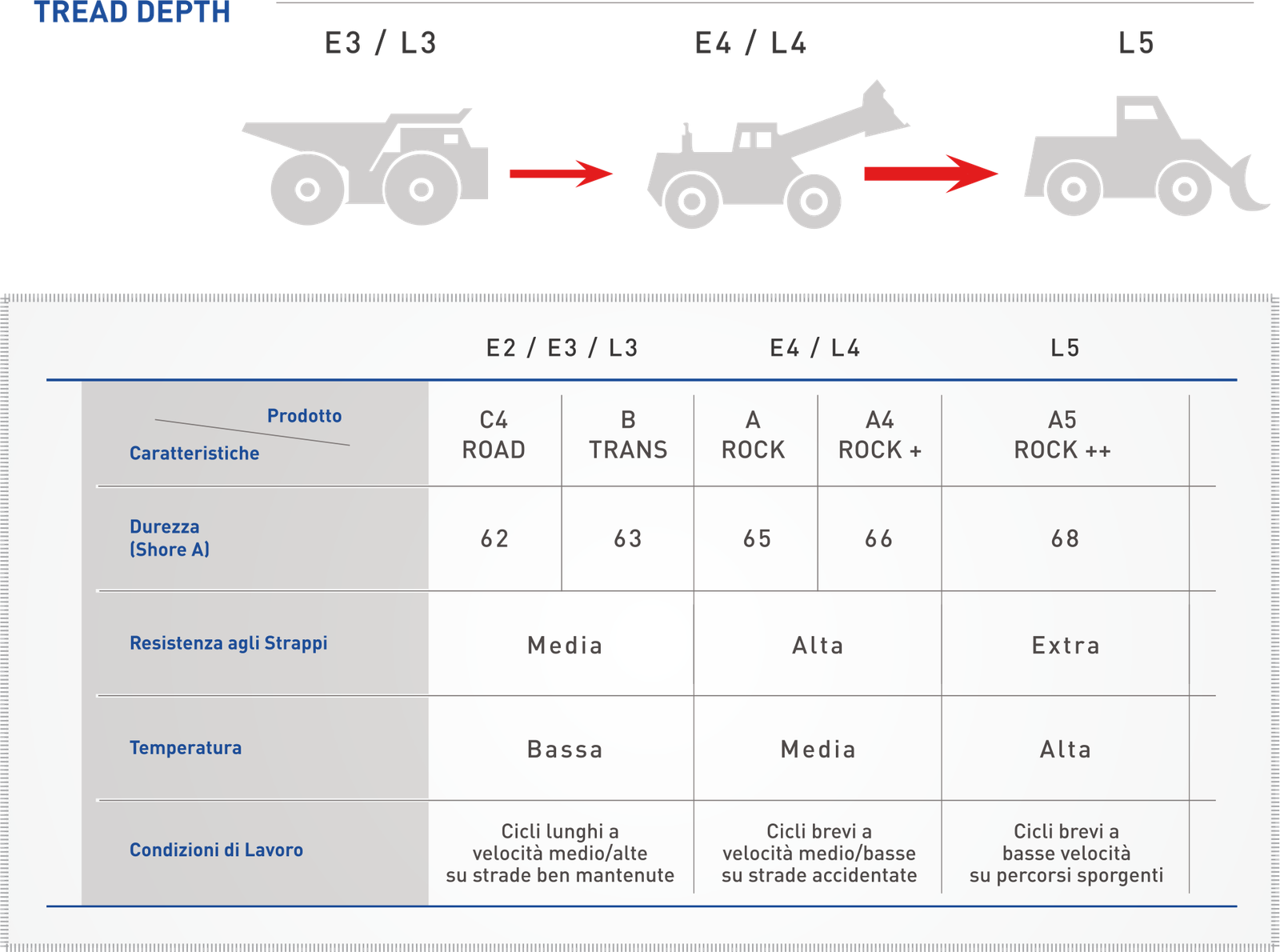
On top of that, there is the need for tread compounds with characteristics suitable for the various applications the tires are intended for (mining, transport, road and building construction sites, etc.).
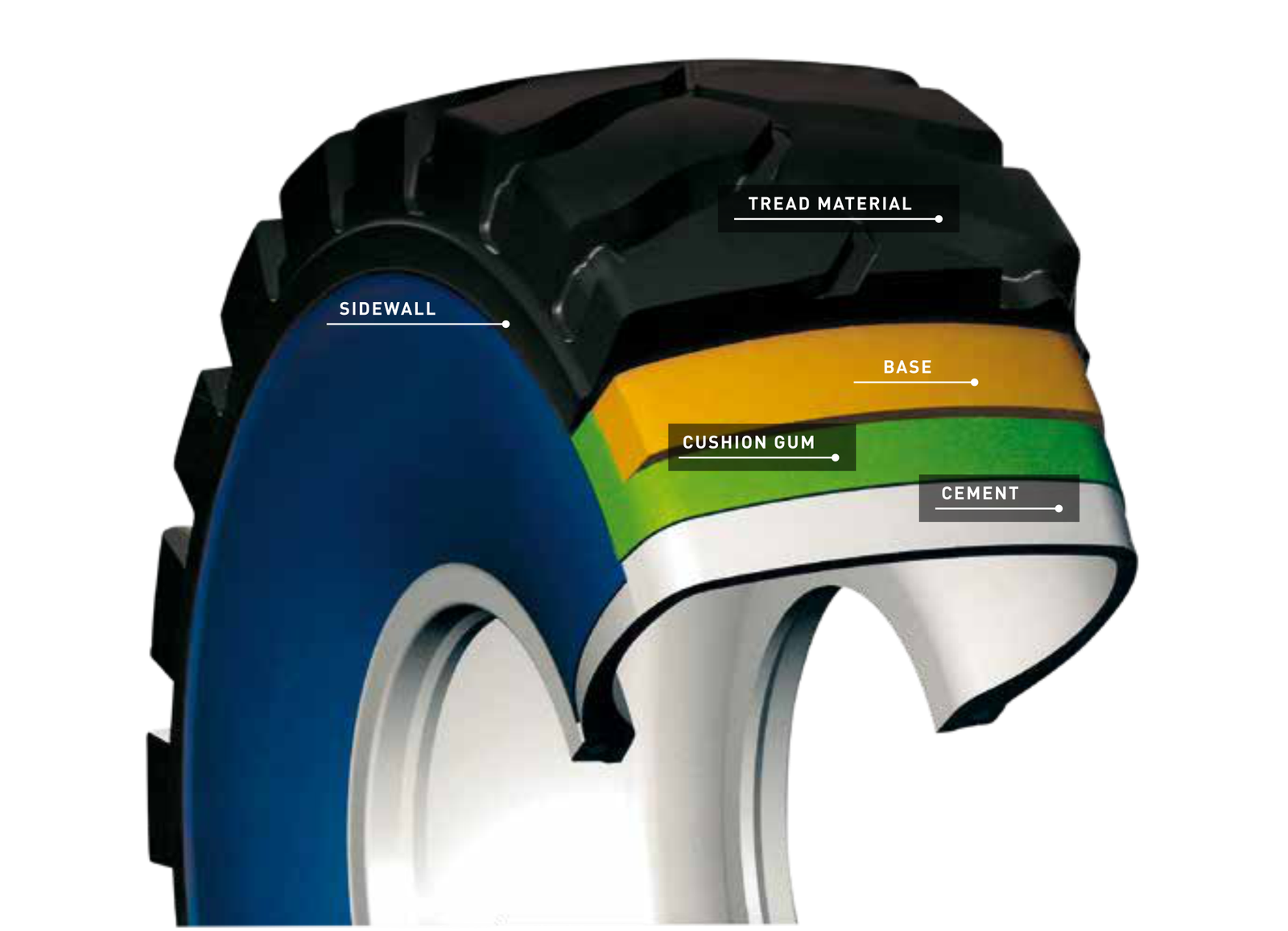
The section of an earthmoving tire shows the composition of the tread, which typically consists of three elements:
1) Tread – the compound that comes into contact with the road surface and, therefore, differs depending on the intended use of the tire (mining, transport, compaction, dumping), with physical characteristics aimed at achieving the required performance (cut resistance, abrasion resistance, and heat generation).
2) Base – an intermediate compound with low heat generation, which, while maintaining high mechanical properties, must have as its main feature high resilience.
3) Substrate- the compound that connects the carcass and the tread. It must have a high vulcanization speed, but at the same time, it must protect the compounds above from premature vulcanization.
4) Sidewall- the compound that covers the sidewall, which is typically scraped and repaired from cuts caused by previous use. The formulation must restore the primary characteristics of the sidewall compound: ozone resistance and fatigue resistance.
In addition to the tread compounds, our offering includes the Cushion (Substrate), Base, Sidewall, and Solution compounds.
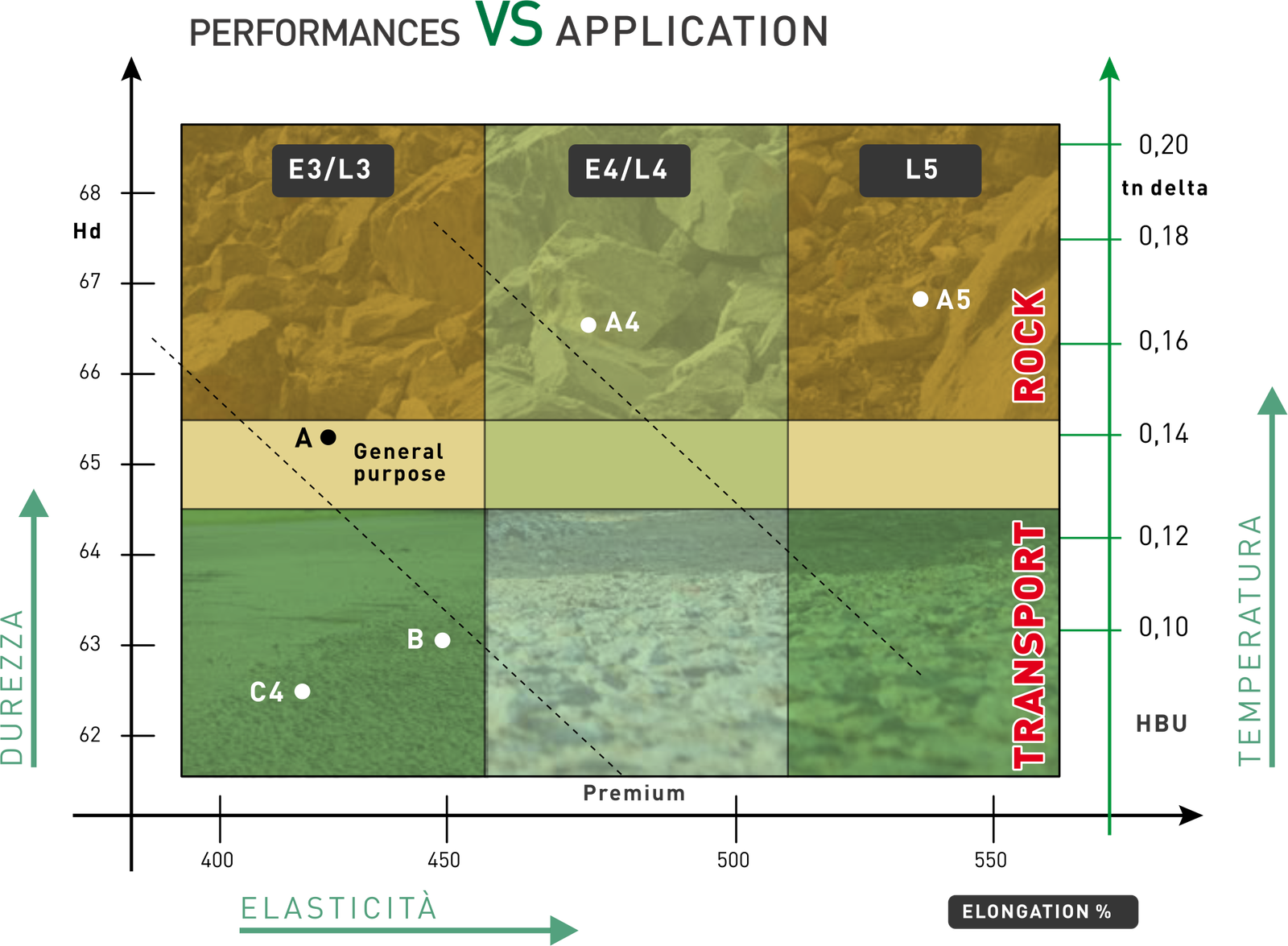
The graph illustrates the map of different formulations of the tread compound for use and various travel ratios on road, terrain, and rock.
The physical characteristics that represent the entire working cycle of a tread compound for OTR tires are as follows:
- Hardness (Shore A): The hardness of the compound controls two fundamental performance aspects: the penetration of the stone into the rubber and the abrasion resistance.
- Elongation (%): The resistance to elongation before breaking controls the elasticity of the compound and its resistance to the propagation of cuts.
- Tan delta. This is a parameter that measures the ability of the compound to not heat up during the deformation cycle (the lower the value, the higher the resilience and the lower the heat generation). Internal friction within the compound, induced by the amplitude and frequency of deformation, generates heat and raises the internal temperature of the tire until the carcass elements begin to separate.
Therefore, for each tire use (mining, construction site), there will be a compound with these three parameters optimized to provide adequate performance for traction requirements, load resistance, and durability relative to the severity of the work cycle.
Our solutions are designed to ensure long-lasting durability, effectively resisting wear and mechanical stress, even in challenging operating conditions.
We offer products that guarantee consistent performance over time, providing our customers with the assurance that every application functions optimally, without surprises.
Our solutions optimize production efficiency and reduce operating costs, thanks to compounds and materials that combine high performance with a lower economic impact.
See also

Truck Tyre, Tread Compound DRIVE-TRACTION
DRIVE-TRACTIONTREAD COMPOUND The tread compounds of a traction tire must transmit motion and convert the engine axle rotations into the [...]

Truck Tyre, Tread Compound CITY BUS
CITY BUSTREAD COMPOUND The key characteristics of tread compounds for bus tires used on urban and interurban routes are all [...]

Truck Tyre, Tread Compound
TRUCK TYRETREAD COMPOUND The formulation and mixing quality of the tread compound determine truck tire performance: mileage, traction, tear resistance, [...]
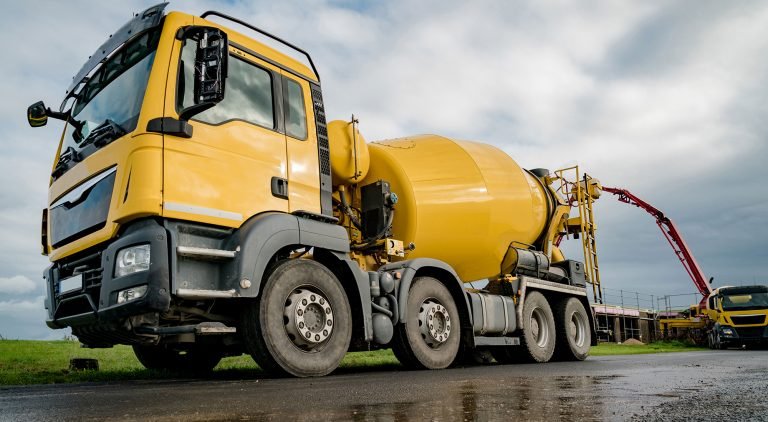
Truck Tyre, QUARRY CONSTRUCTION SITE – CONCRETE MIXER
QUARRY CONSTRUCTION SITE - CONCRETE MIXERTREAD COMPOUND The compounds for quarry construction site tires must allow the vehicle to achieve [...]