TECHNICAL COMPOUNDS
AEM - Ethylene Acrylate Rubber
Description
Ethylene Acrylate Rubber (AEM)
Hardness Range
From 40 to 90 Shore A
Nitrosamine Free
Available on request
Transformation System
Injection / Compression / Extrusion / Calendering / Rubber-to-metal bonding
Vulcanization
System based on diamines and accelerators sensitive to carboxylic groups
Field of Application
Automotive / Chemical / Electrical / Industrial / Applications in low and high temperature environments
Main Reference Standards
Standards of major manufacturers / According to specification / ISO 1431 / ASTM D1418
TECHNICAL ARTICLE COMPOUNDS
ETHYLENE ACRYLATE
RUBBER
Classification
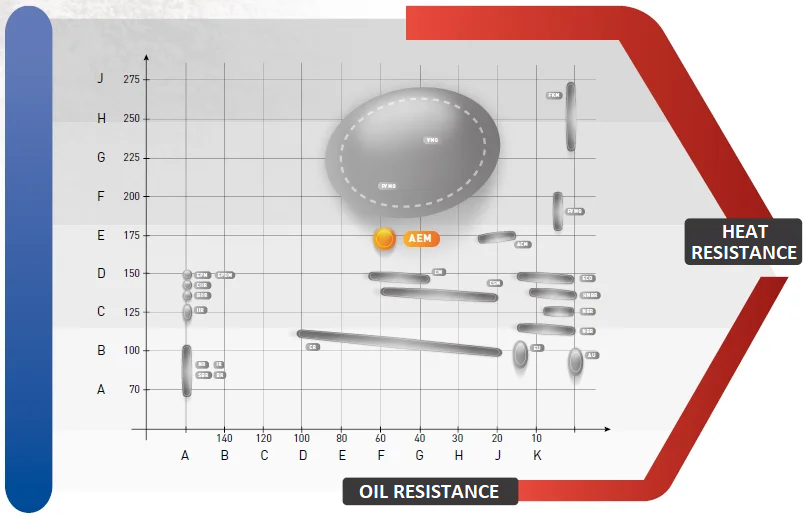
These special elastomers, introduced by Dupont in 1975, constitute an interesting combination of resistance to high and low temperatures, oils and coolants, inorganic acids and bases, and atmospheric agents.
Polymer type
Ethylene-acrylate elastomers are obtained by copolymerizing ethylene and methyl acrylate with small amounts of monomers containing carboxyl groups, classified as “cure-site”. This particularity allows efficient vulcanization using diamines and other accelerators sensitive to carboxyl groups. These elastomers exhibit good physico-mechanical properties when using standard reinforcing fillers. The ethylene structure provides good low-temperature properties, while methyl acrylate provides oil resistance. The fully saturated structure ensures high resistance to ozone, UV radiation, and atmospheric agents. Grades with higher acrylate content and improved oil resistance are also available.
Applications
The compounds based on ethylene-acrylate elastomers can be used to produce items with hardness ranging from 40 to 90 Shore A.
Formulation adjustments are possible depending on various transformation technologies (molding, extrusion, calendering, rubber/fabric and rubber/metal adhesion) and to meet any specific request or specification requiring the use of this elastomer. The most common technical items find applications in the automotive, chemical, electrical sectors, and wherever good performance is required at both high and low temperatures, in basic and acidic environments, with resistance to ozone and weathering, and good electrical properties.
See also

SBR STYRENE-BUTADIENE RUBBER
TECHNICAL COMPOUNDSSBR - Styrene-Butadiene Rubber Description Styrene-Butadiene Hardness Range From 40 to 90 shore A Nitrosamine free Available on request [...]

NR NATURAL POLYISOPRENE RUBBER
TECHNICAL COMPOUNDSNR - Natural Polyisoprene Rubber Description Natural rubber Hardness Range From 30 to 90 shore A Nitrosamine Free Available [...]

NBR NITRILE RUBBERS
TECHNICAL COMPOUNDSNBR - Nitrile Rubbers Description Nitrile Rubber Hardness Range From 40 to 90 shore A Nitrosamine free Available on [...]

IIR BUTYL / HALO-BUTYL RUBBER
TECHNICAL COMPOUNDSIIR - Butyl / Halo-Butyl Rubber Description Butyl Rubber Hardness range From 50 to 70 shore A Nitrosamine free [...]