Eurorubber Industries, based in the province of Parma, Italy, was born as a compounder of compounds for tire retreading and since 1970 has been producing rubber compounds for many of the main industrial sectors: automotive (e.g. rollers, bellows gaskets, anti-vibration mounts, sleeves and fairleads), building and urban planning (e.g. electrical cable sheaths, ceramic mills, conveyor belts, cable lugs and belts), household items (e.g. carpets and clamps), anti-seismic and viaducts (e.g. anti-vibration mounts), household appliances (e.g. portholes for washing machines and pots expansion), nautical (eg sea items: fins, masks) and generic technical items (eg o-rings and various gaskets).
The results obtained over time, the high quality of the products and the constant supplying commercial relationship with many of the main Italian and European companies make Eurorubber Industries one of the most popular brands in the sector. Over time, the traditional sectors of the tire industry have been joined by all the main sectors of the technical article such as conveyor belts and components for the mining industry, automotive components, high pressure pipes and numerous industrial items.
Since January 2020, the company has been part of the Certech Group which has acquired 100% of the corporate shares of Eurorubber Industries, owned by the Marangoni Group in the last three decades. Certech Group is a company among the leaders in the production, installation and assistance of systems and components for ceramic processing based in the province of Reggio Emilia.
Eurorubber Industries is synonymous with quality and tailor- made offer
In addition to consolidated products whose characteristics are the result of constant innovation, Eurorubber Industries develops solutions dedicated to customer needs and is available for the development of any type of customized application. The company is constantly committed to trying to meet all customer needs, always guaranteeing product quality, flexibility to requests and remarkable timeliness. To meet customer requests, the R&D department is able to modify and optimize already existing basic recipes, or develop new custom-made doughs from scratch. This translates into a very high degree of customization of the compounds, in order to provide a final product that is perfectly suited to the specific production needs of the customers. The company thus establishes a synergistic collaboration with the customer who becomes a co-actor in the development phase. In many cases, moreover, it is possible to perfect the development phase of the compounds also in the subsequent molding phases, directly on the production lines of the customers.
Quality takes the form of meticulous attention to customer needs. The continuous improvement, the attention in the choice of raw material suppliers, the consolidated production processes and the cutting-edge production lines, the technically trained and highly motivated staff are the means by which the company tries to satisfy all the requests of the customers.
Eurorubber has also been working since 1999 in compliance with the ISO 9001 series and since 2008 the company has implemented and maintains a quality system in compliance with the UNI EN ISO 9001: 2008 standard and from 2019 UNI EN ISO 9001: 2015 QUALITY and UNI EN ISO 14001: 2015 ENVIRONMENT.
Attention to detail is guaranteed by the strict internal procedures, designed to monitor the various production processes, and by an integrated traceability system that starts from the raw materials to reach the single batch of each lot. This allow us delivering a product of absolute quality to the customer. The types of compounds that Eurorubber are responsible for are: NBR – BR – SBR – NR – CR – EPDM – Butyl – Chlorine Butyl and are characterized by a viscosity ranging from 20 to 140 Mooney and a hardness from 30 to 95 shore.
Certech Group rilancia Eurorubber Industries e il progetto con Bosch Rexroth ne rappresenta un esempio concreto
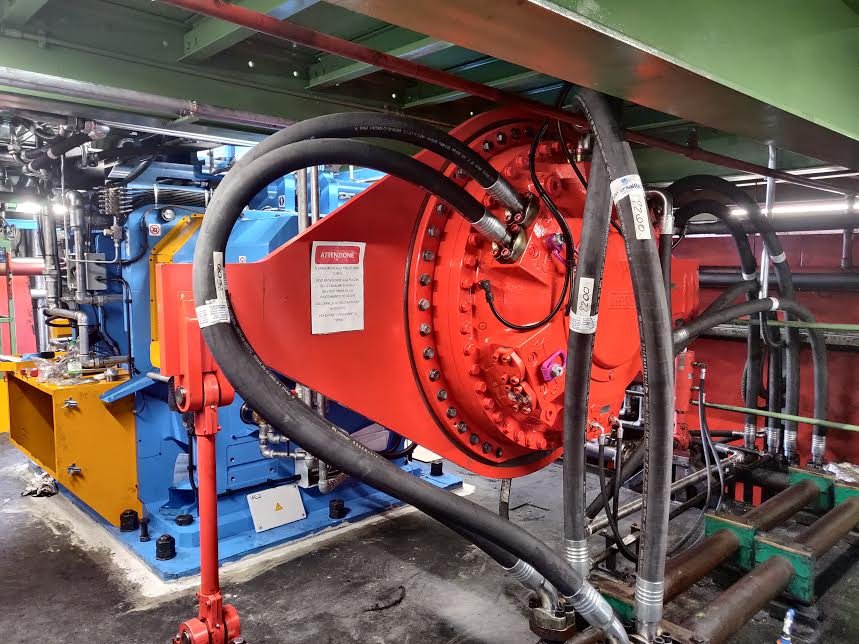
The collaboration of Eurorubber Industries with Bosch Rexroth was born in 1996, with the installation of the first tangential mixer of 240 liters and continues today thanks to the revamping project of the Internal Mixer which involves the application of a new generation Hagglunds CBM 1200 engine to replace an old Hagglunds MB 1150 motor. Eurorubber Industries has always chosen Bosch Rexroth for its great reliability, transparency, propensity for innovation and customer service. All qualities put into practice with professionalism and attention to timing, in order to guarantee great synergy. And precisely for this important phase of relaunching the company with the leadership of Certech Group, it was again chosen to collaborate with Bosch Rexroth. This partnership also looks to the future, particularly in the field of pumps, for greater performance and the development of a latest generation product.
One of the strengths of the Hagglunds CBM 1200 engine, the flagship of Bosch Rexroth, is the opportunity to upgrade the engine to the new machine. It is a Plug & Play product, which allows you to not have to apply any mechanical changes as it is interchangeable. This state-of-the-art motor offers higher yields, therefore with the same technical characteristics it is capable of guaranteeing better performance with an advantage for the customer also from an energy point of view. The machine being renovated is the Internal Mixer or closed mixer: generally closed mixers are driven by an electromechanical system.
The Hagglunds high torque motor, besides being able to be mounted directly, therefore without the interposition of gear reducers, offers numerous advantages regarding compactness (reduced size), 100% torque at zero rpm, a variable speed from 0rpm to maximum speed, the possibility of working in pull, push, clockwise and anticlockwise and the high dynamics which translates into an increase in production.
The benefits of Hagglunds on the closed mixer
Among the most obvious benefits there is certainly the smaller footprint around the mixer which sees the disappearance of the reducer and the electric motor and the reduction of the machine base and the fact that the power unit can be positioned remotely. In addition, the initial investment is safeguarded and includes the ability to increase performance thanks to small changes that can be made without upsetting the system. In interpenetrating mixers the friction is not variable, it is fixed. Precisely because the rotor crests intersect with each other, they must always be in phase.
Productivity actually increases because with the interpenetrating compound with variable center distance it is possible to produce the compounds in a single phase, eliminating the double phase master batch and final batch. The improvement of the dispersion of the various products is given precisely by the conformation of the rotors.
The interpenetreting rotor
An interpenetrating mixer has a 2-shaft rotor system and the rotor of each shaft is in gear with the other. Mixing takes place not only between the rotor and the chamber wall, but also between the two rotors. Since the rotor clearance is low, the entry of the raw material is slower than that of the tangential rotor and generally the cycle time increases.
However, when a greater shear force is applied between the rotors, the properties of the rubber
can improve. In addition, due to its excellent distribution and cooling performance, the combined rotor system is particularly suitable for heat-sensitive compounds and high-quality mixing of various types of rubber.
Furthermore, the large reserve of torque available continuously allows to solve critical situations: if a blackout causes the compound in the chamber to cool down, the Hagglunds motors are able to restart the system, and the particular lightness in the supply of torque reduces the risks of mechanical failures.
The fields of application are numerous and include rubber (e.g. closed and open mixers, calenders and extruders), the recycling sector (e.g. shredders, slow shredders, conveyor belts), mining and material handling, cement (e.g. rotary kilns, crushers, bucket elevators), chemicals (e.g. reactors, agitators, dryers), the plastics industry (e.g. injection molding machine) and marine and offshore (e.g. winches, ship and loader).
As regards the internal mixer, the technology of the tangential mixer was abandoned to move on to the latest generation, therefore with interpenetrating rotors with variable interest. On the Hagglunds drive side, one of the great advantages over closed mixers is linked to the very high dynamics of the system compared to the mechanical solution. When the components of a recipe are loaded into the closed mixer, the machine must vary according to how it must mix the recipe that has been inserted and make speed variations, then it must increase and decrease until it reaches the maximum speed for when loading the final part / chemistry. Between one speed change and the next with the Hagglunds system you get an immediate increase. It means that at the end of the batch, 3 seconds are recovered on the compound produced, which means a significant increase in production over a year.